Eggs
4. Different ways of cooking eggs
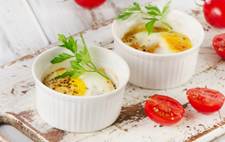
1) Baked
Eggs, or their individual parts (whites and yolks) are used in baking to bind liquid and solid ingredients, while adding flavour, moisture and colour to cakes. An example of egg whites used on their own is in the making of meringues.
2) Boiled
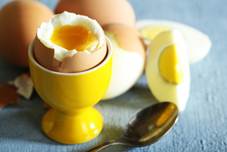
Eggs can be soft-boiled or hard-boiled, served on their own, as a garnish or combined with other ingredients to make appetizers. They also act as standalone dishes, examples of which include an egg salad, Scotch egg, eggs mornay or eggs au gratin.
A number of factors affect eggs when cooking them. The shorter the time that they are cooked, the runnier they will be. And, with altitude affecting the time it takes to boil an egg, the higher one is in altitude, the longer it will take to cook. This means that eggs in Johannesburg take longer to cook than in Cape Town.
It is important that eggs are submerged in water and that the timing only begins when the water is boiling. Roughly speaking, it takes on average 3 minutes to soft boil a large egg and 10 minutes to hard boil but, if placing eggs in cold water to start (instead of hot water), the cooking time can be reduced by 1 minute.
Once cooked, they can be submerged in cold water to help the shell come off easily and to prevent the yolk from becoming discoloured.
3) Custards
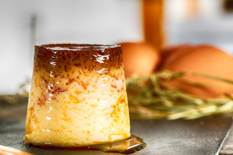
Egg custards can be baked or stirred. The egg helps the dish to coagulate. Baked custards are smooth, firm and yellow. Stirred custards are paler, thicker and served to be poured. Baked custards normally require a bain-marie in order to keep the oven moist and avoid separation, bubbles or burning during the cooking process.
4) Fried
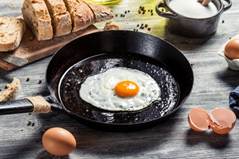
Eggs, shallow fried in butter or oil, can be soft-set or firm-set and classified as either sunny-side up (i.e. only fried on one side) or easy-over (i.e. fried on both sides) - they should be served immediately after cooking.
Moderate heat should be used to avoid burning the egg whites; the oil should be hot, but not bubbling. A lower temperature should be used when soft-set, sunny-side up eggs are requested in order to keep the egg yolk runny. Easy-over eggs are cooked normally, then flipped and lightly cooked with the yolk facing down in the pan. Fried eggs should be milky white, shiny but not greasy and the yolk should be bright yellow.
5) Omelettes
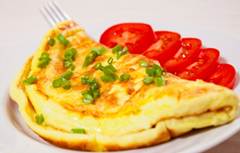
Omelettes are basically beaten eggs that are quickly fried at a moderate to high heat, forming a solid coagulated sheet of egg. They are normally served savoury but can also be sweet. The classic French Omelettes, which can have a wide variety of sweet and savoury fillings, are served 'folded'.
To cook an omelette for one person, gently beat 2 eggs and pour into the base of a frying pan. Cook until the bottom of the omelette is golden brown but the top remains moist. Fold, season and serve. The omelette should be light and evenly cooked, and can often have other ingredients added to it (like tomatoes and cheese).
6) Poached
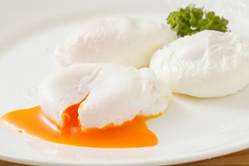
Eggs, cooked without a shell in hot water, can be served soft, medium or hard. Examples of dishes using poached eggs are Eggs Benedict, Eggs Bombay and Eggs Florentine.
To cook poached eggs, use either a poacher or shallow pan and keep the water below boiling at a temperature of about 80-90°C. Add a pinch of salt or a couple of drops of vinegar to help the egg whites set. Once a gentle whirlpool has been created, eggs can be cracked directly into the hot water or into a small ramekin (before being carefully placed in the water).
Simmer the eggs until the white appears to be fully coagulated, tender and soft to touch. It is important not to overcook the yolk. Remove the eggs with a slotted spoon and trim any excess before serving or storing (in cold water).
7) Scrambled
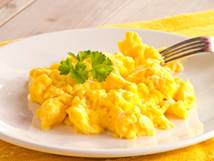
To scramble eggs, beat them gently before cooking them slowly with a little milk in a saucepan on a moderate heat. Stirred occasionally, they should be light and not dry. Other ingredients can be added such as fresh herbs, chopped ham or grated cheese.
On a per person basis, pre-mix 2 eggs and a little milk in a bowl. Pour the mixture into a heavy bottomed pan. If using additional ingredients, add these in towards the end.