Eggs
| Site: | DBECloud |
| Course: | Grade 10 e-Hospitality Studies |
| Book: | Eggs |
| Printed by: | Guest user |
| Date: | Thursday, 22 October 2026, 11:42 AM |
Description
1. Introduction
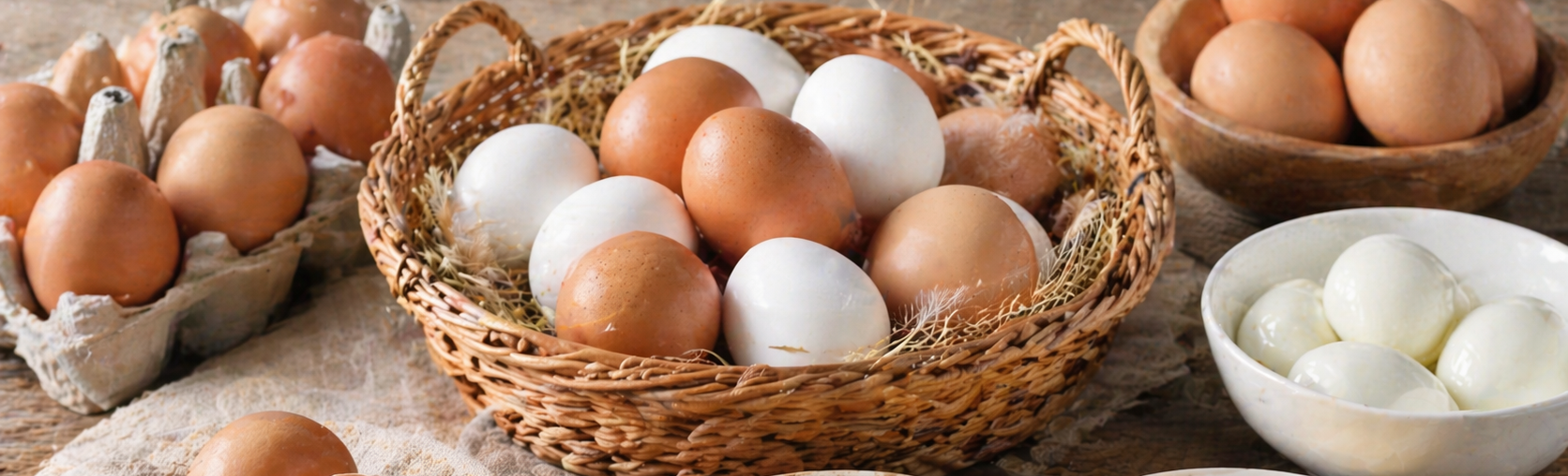
Eggs are a versatile food commodity – they can be served alone or used as an ingredient in cooking. Coming in many sizes and from a number of different birds, they are high in nutritional value and a great source of protein.
2. Types, Sizes and States of Eggs
The smallest egg is the quail egg, followed by the chicken egg. Next in size is a duck egg (about 1.5x the size of a chicken egg), the goose egg (about 2-3x the size of a chicken egg) and finally an ostrich egg (which is about 8-12x the size of a chicken egg). The size and flavour of these eggs lends them to different uses.
Chicken eggs are the most common egg. They are graded based on mass (grams), where large is the most predominant egg in commercial service operations. The full range is:
Small: more than 33g (<43g)
Medium : more than 43g (<51g)
Large: more than 51g (<59g)
Extra large: more than 59g (<66g)
Jumbo: more than 66g
Eggs can also come in available in different states, namely…
1. Fresh eggs
These will have a use by date on each individual egg or on the packaging.
2. Frozen eggs
Are available in pulp (the whole egg) or individual whites and yolks. Both come without shells. Egg pulp is commonly used for industrial baking (as it is time saving) and the eggs are normally homogenised and pasteurised before freezing.
3. Dehydrated eggs
Similar to frozen eggs, they are available whole, or in individual parts. They are used in custard powders, cake mixes and soups. Dehydrated eggs must be kept in the refrigerator.
3. Uses of Eggs
- - Binding: cooking makes eggs coagulate which holds a mixture together (e.g. stuffing, burger patties, frittata)
- - Clarifying: adding egg whites to stocks helps to make the final product clear (e.g. consommé́, aspic jelly)
- - Coating: beaten whole eggs coated on food items protect them during cooking and results in a crisp finish (e.g. deep fried food, croquettes)
- - Egg dish: as the main ingredient in a food serving (e.g. omelette, baked custard)
- - Emulsifying: beaten eggs (whole or yolk only) hold ingredients together in a mixture; even ingredients that don't normally mix well together (e.g. mayonnaise, hollandaise sauce)
- - Enriching: adding eggs to food adds flavour and nutrients, and can boost colour too (e.g. cakes, pasta, puddings, drinks like eggnog)
- - Garnishing: hard boiled eggs can be sliced or chopped and used to garnish food (e.g. salads)
- - Glazing: beating eggs (whole or yolk only) and brushing them on food items before cooking results in a glazed and golden finished product (e.g. pastries, breads, pommes duchesse)
- - Thickening: beaten eggs (whole or yolk only) coagulate and hold mixtures together (e.g. soups, sauces, custards)
4. Different ways of cooking eggs
1) Baked
Eggs, or their individual parts (whites and yolks) are used in baking to bind liquid and solid ingredients, while adding flavour, moisture and colour to cakes. An example of egg whites used on their own is in the making of meringues.
2) Boiled
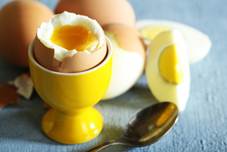
Eggs can be soft-boiled or hard-boiled, served on their own, as a garnish or combined with other ingredients to make appetizers. They also act as standalone dishes, examples of which include an egg salad, Scotch egg, eggs mornay or eggs au gratin.
A number of factors affect eggs when cooking them. The shorter the time that they are cooked, the runnier they will be. And, with altitude affecting the time it takes to boil an egg, the higher one is in altitude, the longer it will take to cook. This means that eggs in Johannesburg take longer to cook than in Cape Town.
It is important that eggs are submerged in water and that the timing only begins when the water is boiling. Roughly speaking, it takes on average 3 minutes to soft boil a large egg and 10 minutes to hard boil but, if placing eggs in cold water to start (instead of hot water), the cooking time can be reduced by 1 minute.
Once cooked, they can be submerged in cold water to help the shell come off easily and to prevent the yolk from becoming discoloured.
3) Custards
Egg custards can be baked or stirred. The egg helps the dish to coagulate. Baked custards are smooth, firm and yellow. Stirred custards are paler, thicker and served to be poured. Baked custards normally require a bain-marie in order to keep the oven moist and avoid separation, bubbles or burning during the cooking process.
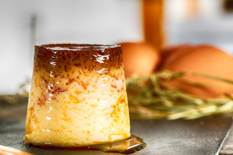
4) Fried
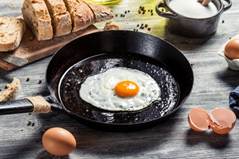
Eggs, shallow fried in butter or oil, can be soft-set or firm-set and classified as either sunny-side up (i.e. only fried on one side) or easy-over (i.e. fried on both sides) - they should be served immediately after cooking.
Moderate heat should be used to avoid burning the egg whites; the oil should be hot, but not bubbling. A lower temperature should be used when soft-set, sunny-side up eggs are requested in order to keep the egg yolk runny. Easy-over eggs are cooked normally, then flipped and lightly cooked with the yolk facing down in the pan. Fried eggs should be milky white, shiny but not greasy and the yolk should be bright yellow.
5) Omelettes
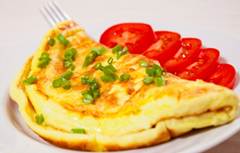
Omelettes are basically beaten eggs that are quickly fried at a moderate to high heat, forming a solid coagulated sheet of egg. They are normally served savoury but can also be sweet. The classic French Omelettes, which can have a wide variety of sweet and savoury fillings, are served 'folded'.
To cook an omelette for one person, gently beat 2 eggs and pour into the base of a frying pan. Cook until the bottom of the omelette is golden brown but the top remains moist. Fold, season and serve. The omelette should be light and evenly cooked, and can often have other ingredients added to it (like tomatoes and cheese).
6) Poached
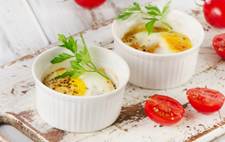
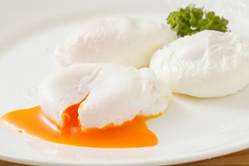
Eggs, cooked without a shell in hot water, can be served soft, medium or hard. Examples of dishes using poached eggs are Eggs Benedict, Eggs Bombay and Eggs Florentine.
To cook poached eggs, use either a poacher or shallow pan and keep the water below boiling at a temperature of about 80-90°C. Add a pinch of salt or a couple of drops of vinegar to help the egg whites set. Once a gentle whirlpool has been created, eggs can be cracked directly into the hot water or into a small ramekin (before being carefully placed in the water).
Simmer the eggs until the white appears to be fully coagulated, tender and soft to touch. It is important not to overcook the yolk. Remove the eggs with a slotted spoon and trim any excess before serving or storing (in cold water).
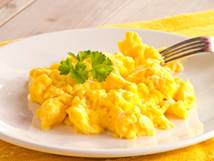
7) Scrambled
To scramble eggs, beat them gently before cooking them slowly with a little milk in a saucepan on a moderate heat. Stirred occasionally, they should be light and not dry. Other ingredients can be added such as fresh herbs, chopped ham or grated cheese.
On a per person basis, pre-mix 2 eggs and a little milk in a bowl. Pour the mixture into a heavy bottomed pan. If using additional ingredients, add these in towards the end.
5. Quality characteristics of good eggs
From the outside, the egg should…
- be clean and not cracked
- be any colour (from white to brown) but not at all shiny (stale eggs go shiny)
- feel solid, not hollow (the older the egg, the more air it has in it)
On the inside (as if cracked onto a plate)…
- - the egg white should be thick, gel like and see-through - the older the egg, the more runny the egg white
- - the egg yolk should be firm and translucent (the colour can range from very pale yellow to very bright yellow)
- - the whole egg should be free from blemishes (blood or black spots, yolk breakage, bits of shell)
6. Factors influencing the texture of eggs
Coagulation
Coagulation of egg whites takes place at around 60-65°C and yolks at around 65-70°C. Mixing eggs with other food products can change the temperature at which this happens. Adding sugar, for example, raises the coagulation temperature, while adding salt lowers it. Adding liquid (e.g. milk or water) to eggs dilutes the concentration of proteins and as such increases the temperature required for coagulation to take place.
Whisking/Beating of Egg Whites
Beating egg whites changes their texture and the best way to achieve a light, yet stiff result is by using a balloon whisk to beat them at room temperature. The act of whisking incorporates air into the mixture, resulting in soft, medium or firm 'peaks'. Soft and medium mixes are used for 'foamy' type foods (e.g. soufflés) while firm mixes are predominately used for meringues. Whisking eggs too much will result in granulation and dryness.
Once beaten, eggs should be used immediately to prevent them from losing air and becoming watery. Most recipes call for beaten egg whites to be folded into a mixture at room temperature, since adding them to a hot mixture will cause them to collapse. Beaten egg whites can be stabilised with the addition of a little acid like vinegar, lemon juice or cream of tartar.