 TOPIC OVERVIEW
| Unit 6.1 | Primary, secondary and tertiary sectors |
| Unit 6.2 | The differences between formal and informal sectors |
| Unit 6.3 | The differences between public and private sectors |
 Learning objectives
At the end of this topic, learners should be able to:
 Key concepts
 New words
registered businesses in South Africa, businesses must register with the South Africa Revenue Service (SARS) for purposes of tax
In Grade 9 Economic and Management Sciences (EMS) you learned about the Sectors of the Economy in Entrepreneurship. We will continue learning about these sectors but focus on:
In Grade 11 we will link the three sectors and in Grade 12 we will focus on identifying the business sectors and the classification of the challenges according to the three business environments.
Business sectors consist of businesses that are grouped together and classified into primary, secondary or tertiary sectors. How the business is classified depends on the nature of its product or service.
The purpose of the classification is to determine the contribution of each sector and industry to the South African economy. Businesses play a huge role in making a meaningful contribution within the different sectors.
New words
industry refers to a specific group of businesses that produce a particular kind of good or service in a particular field
 Take note
The terms sector and industry are often used interchangeably. However, an industry refers to a specific group of businesses that produce a particular kind of good or service in a particular field. For example, the tourism industry includes travel services, hotels, shared accommodation, tourist attractions, recreation and entertainment, and conferences.
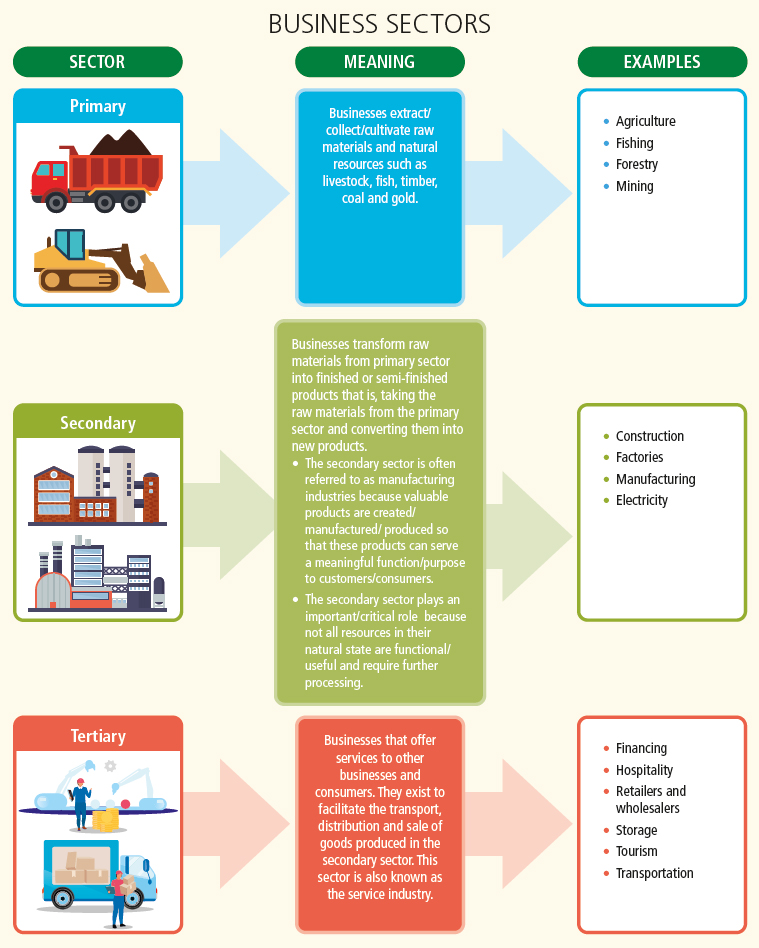
The sectors can be classified as follows:
 Did you know
The contribution of the top sectors to the GDP on 3 September 2020 were:
Primary sector: Mining 14,4%
Secondary sector: Electricity 3,2%
Tertiary sector: Finance, Real estate & business services 4,1%
[Source: https://www.southafricanmi.com/south-africas-gdp.html]
The sectors work together to create an economic chain of production.
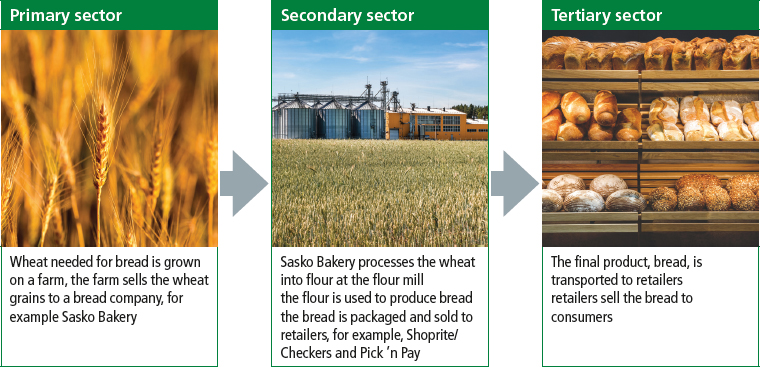
The primary sector gathers the raw materials, the secondary sector transforms the raw materials into useful goods. The tertiary sector sells the goods or services and supports the activities of the primary and secondary sectors.
Let us have a look at how a product such as BREAD reaches the table of a consumer.

However, the relationship between the three sectors is not a linear one.
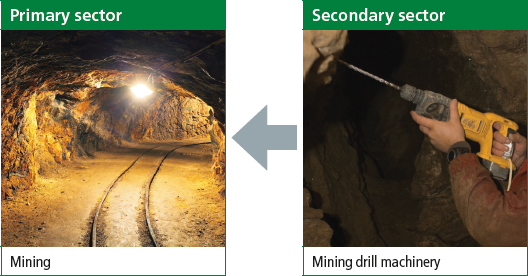
The primary sector also depends on the secondary sector for manufactured goods such as machinery and equipment.
Did you know
Sasko Bakery also sells flour as a final product to retailers that consumers can buy to bake their own bread.
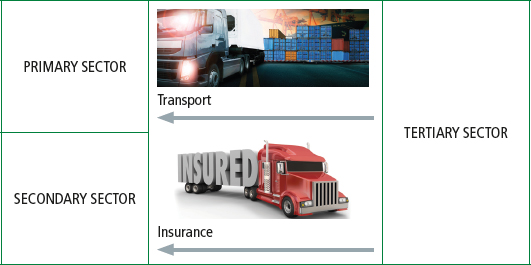
The primary and secondary sector also depends on the tertiary sector to provide services such as insurance and transport.
 Activity 6.1 Business sectors
1.1State the THREE business sectors. (3)
1.2Explain the relationship between the three business sectors. (6)
Tip 
Only the first TWO answers will be marked if more than the stated number of facts are given.
Tip
When required to quote from the scenario, rewrite the applicable sentence in full, directly from the scenario.
Businesses operating in South Africa are divided into the formal and informal sector.
The formal sector is mainly characterised by small, micro, medium and large businesses with specific working hours and monthly salaries or weekly wages. These businesses have a specific aim of making a profit. Examples of businesses in the formal sector include mines, farms, manufacturers, construction, retailers, and insurance companies.
The informal sector consists of small businesses with long working hours and irregular income. These small businesses are mostly started by the unemployed people who need to earn an income to buy necessities or pay for things such as water and electricity. Examples of businesses in the informal sector include food and flea markets, street vendors, and spaza shops.
With increasing unemployment in South Africa, the informal sector is growing bigger since many people are using their entrepreneurial skills to generate some form of income to survive.
Did you know
The official unemployment rate in South Africa ranks as one of the highest in the world. In the fourth quarter in 2020, the unemployment rate increased to 32,5%.
[Source: https://www.enca.com/business/unemployment-rate-rises-325-percent]
Meaning of formal sector
Businesses in the formal sector are registered and pay taxes. These businesses are required to register with the Companies and Intellectual Property Commission (CIPC). Businesses have to register with the South African Revenue Services (SARS) and be liable to pay tax on turnover and profits at prescribed threshold.
Meaning of informal sector
Businesses in the informal sector are not registered with CIPC and do not pay tax on profits to SARS.
The informal sector refers to those workers who are self-employed. Owners of businesses in the informal sector take responsibility for the success and failure of their businesses.
Did you know
You must register your business if the total value of taxable goods or services is more than R1 million in a 12-month period, or is expected to exceed this amount.
A business may also register voluntarily if the income earned in the past 12-month period exceeded R50 000.
New words
prescribed thresholdrefers to predetermined amount
self-employedrefers to people working for themselves
Differences between formal and informal sectors
FORMAL SECTOR |
INFORMAL SECTOR |
|---|---|

|

|
Businesses in the formal sector are registered with CIPC. Businesses pay tax to SARS on turnover and profit made. |
Businesses in the informal sector are not registered with CIPC. Businesses do not pay tax on the profits of the business. |
Formal sector activities are monitored by the government. |
These businesses are not monitored by the government. |
These businesses are controlled by the laws and regulations of the government. |
Government laws and regulations pertaining to businesses do not apply to the informal sector, but must adhere to municipal regulations. |
All contributions of these businesses are recorded in the total value of the goods and services produced in a country. |
It is difficult to calculate its contribution to the total value of the goods and services produced in a country. |
Employees are protected by legislation such as Basic Conditions of Employment Act, No. 75 of 1997 (BCEA), Compensation for Occupational Injuries and Diseases Act, No. 130 of 1993 (COIDA), Unemployment Insurance Fund (UIF), and so on. |
Employees are not protected by any legislation and can easily be exploited. |
TIP
Remember that the differences between the formal and informal sectors need to be clearly stated.
FORMAL SECTOR |
INFORMAL SECTOR |
|---|---|
Income is regular weekly/monthly earnings. |
Income earned is irregular and inconsistent. |
Employees work specific working hours. |
Employees work long hours. |
Consists of small, micro, medium and large businesses. |
Consists of small-scale home-based operations. |
Examples include companies such as mining, manufacturing, retail and banking. |
Examples include spaza shops, street vendors, hairdressers, gardening services, car wash services and other home-based activities. |
New words
gross domestic product (GDP) a measurement that captures a country’s economic output
 QR CODE
Interesting information on South Africa’s Formal Business Sector:

https://www.southafricanmi.com/south-africas-formal-business-sector.html
The following article describes why the informal sector is important to growing the economy in South Africa. .
 CASE STUDY

1Quote the importance of the informal sector from the case study above.
2Identify THREE types of industries that provides employment in the informal sector.
3Compare the employment in the informal sector and the formal sector.
Activity 6.2
1.1List TWO examples of businesses in the informal sector. (2)
PICTURE A |
PICTURE B |
1.2Classify Picture A and B as businesses forming part of the formal and informal sectors respectively. (2)
1.3Differentiate between the formal and informal sectors. (4)
1.4Advise businesses on the importance of the formal sector. (4)
In South Africa’s mixed economy, most businesses are privately owned and some businesses are state-owned. The privately owned businesses form the private sector and the state-owned businesses form part of the public sector.
New words
mixed economyconsists of both private and state-owned companies that share control of owning, making, selling, and exchanging goods in the country
state-owned companies /enterprises (SOCs/SOEs) refers to a business that is owned and controlled by the government
The public sector comprises of various business enterprises owned and managed by the government.
The private sector consists of business activity that is owned, financed and run by private individuals.
QR CODE
Here is a link to the Public Entities in South Africa:

The public sector plays an important role in South Africa’s economy. It:
TIP
The public sector provides services to the public, and the aim of the private sector is to make a profit.
The private sector in South Africa’s economy:
New words
corporate social responsibility (CSR)relates to businesses that take responsibility for its impact on society and the environment
public-private-partnership (PPP)is a contract between a public-sector institution and private sector, where the private sector performs a function that is usually provided by the public-sector and/or uses state property in terms of the PPP agreement
parastatalis a state-owned company /enterprise (SOCs/SOEs)
Did you know
Public-private partnerships are typically found in transport infrastructure such as highways, airports, railroads, bridges, and tunnels. Examples of municipal and environmental infrastructure include water and wastewater facilities.
PUBLIC SECTOR |
PRIVATE SECTOR |
|---|---|
The public sector comprises of various business enterprises and institutions owned and managed by the government. |
The private sector consists of businesses that are owned, financed and run by private individuals. |
It is the part of the economy, where goods and services of public interest are provided by the government. |
These businesses are privately owned and provide goods and services with the aim of making a profit. |
Businesses in the public sector consist of parastatals and state-owned companies or enterprises (SOCs/SOEs). |
They are privately owned by sole traders, partnerships, close corporations or profit companies. |
They provide public goods and services such as water and electricity to meet the needs of its people. |
They offer a large variety of goods and services to meet the demands of consumers. |
They are tasked with improving the general standard of living of all citizens. |
These companies also give back to the people by uplifting the community through corporate social responsibility programs. |
These companies should ensure the equal distribution of wealth among the rich and poor. |
They provide opportunities for other businesses to create wealth for growth. |
They are also tasked with providing infrastructure that supports private sector development. |
They also support the public sector through public-private-partnership agreements. |
Examples include Eskom, Denel, SABC, South African Airways (SAA), Transnet. |
Examples include banks, hotels, insurance companies, restaurants and retailers. |
TIP
Remember that the difference between the public and private sectors need to be clearly stated.
Activity 6.3 Public sector and private sector
Work on your own
1.1Elaborate on the meaning of the private sector. (4)
1.2Distinguish between the public and private sector. (8)
1.3Discuss the purpose of the public sector. (6)
QR CODE
Read the news article on the future of the uncertainty of SOE’s with arguments against privatisation.

QR CODE
Read the news article on Sasol partnering with local government.

https://infrastructurenews.co.za/2014/08/12/sasolpartnering-with-local-government/
New words
privatisation refers to the sale of state-owned businesses and assets to the private sector
Did you know
In South Africa there have been three interesting cases of privatisation – the privatisation of Steel manufacturer Iscor in 1989, the privatisation of petrochemicals company Sasol in 2000 and the partial privatisation of Telecoms company, Telkom in 2002.
Use the mind map as a guide to consolidate the content covered in this topic. Be sure to study the content relevant to each heading.

SECTION A
QUESTION 1
1.1Various options are provided as possible answers to the following questions. Choose the answer and write only the letter (A – D) next to the question numbers (1.1.1 -1.1.2) in the ANSWER BOOK, for example 1.1.3 D.
1.1.1The … sector refers to industries that offer services.

1.1.2Businesses in the … sector do not pay tax on the profits of the business.
1.1.3The role of the private sector is to …
(3 × 2) (6)
1.2Complete the following sentence by using the words in the list below. Write only the word(s) next to the question number (1.2.1 – 1.2.3) in the ANSWER BOOK.

1.2.1Mr Yokwakha’s construction business is an example of the … sector.
1.2.2Examples of businesses in the … sector include spaza shops found in the township.
1.2.3Denel, a business owned and controlled by the government is an example of the … sector.
(3 × 2) (6)
SECTION B
QUESTION 2
2.1List any TWO examples of industries in the primary sector. (2)
2.2Elaborate on the meaning of the informal sector. (4)
2.3Read the scenario below and answer the questions that follow.
2.3.1Identify TWO business sectors in the scenario above. Motivate your answer by quoting from the scenario above.
Use the table below as a GUIDE to answer QUESTION 2.3.1
BUSINESS SECTORS |
MOTIVATIONS |
|---|---|
1. |
|
2. |
|
(6)
2.3.2Explain the relationship between the TWO sectors identified in QUESTION 2.3.1 (4)
QR CODE
Scan this code for a summary overview of the content covered in this topic relating to the specific Key Learning Points

https://www.youtube.com/playlist?list=PLY8n0zQCEkpoSJuohXHcDHDsxpXbniaM6
PUZZLE: BUSINESS SECTORS

Across 2.The sector where goods and services are provided by the government. 4.An example of an industry in the secondary sector. 5.The sector that deals with the extraction of raw materials. 7.The sector where businesses are not registered. 8.Activity of the primary sector. 10.Activity of the secondary sector. 11.The sector that refers to services. |
Down 1.Refers to the sale of state-owned businesses. 2.The sector that consists of businesses owned by individuals. 3.Give another name for state-owned company. 6.The sector that involves the process of transforming raw materials. 9.The sector where businesses are registered. |

