
 TOPIC OVERVIEW
Unit 17.1 Presenting business information
 Learning objectives
At the end of this topic, learners should be able to:
 outline/explain the importance of presenting business information
differentiate/distinguish between verbal and non-verbal presentations and give examples of each
outline/state/explain/discuss types of visual aids
identify the above mentioned visual aids from given scenarios/case studies/statements
explain/discuss how a presenter must prepare the following visual aids:
discuss/explain/recommend factors that a presenter must consider when preparing a presentation
explain the reasons why business presentations must be in a written format
outline/state/explain types of written information
outline/state/explain/recommend steps in report writing
critically analyse a business report and recommend areas for improvement
outline/state/explain factors that must be considered when composing a flyer
explain how to respond to questions about work and presentations/handle feedback after a presentation in a non-aggressive and professional manner.
 Verbal presentation: the use of speech by a presenter to convey a message to stakeholders/audiences.
Non-verbal presentation: the presentation of information to an audience without using spoken words.
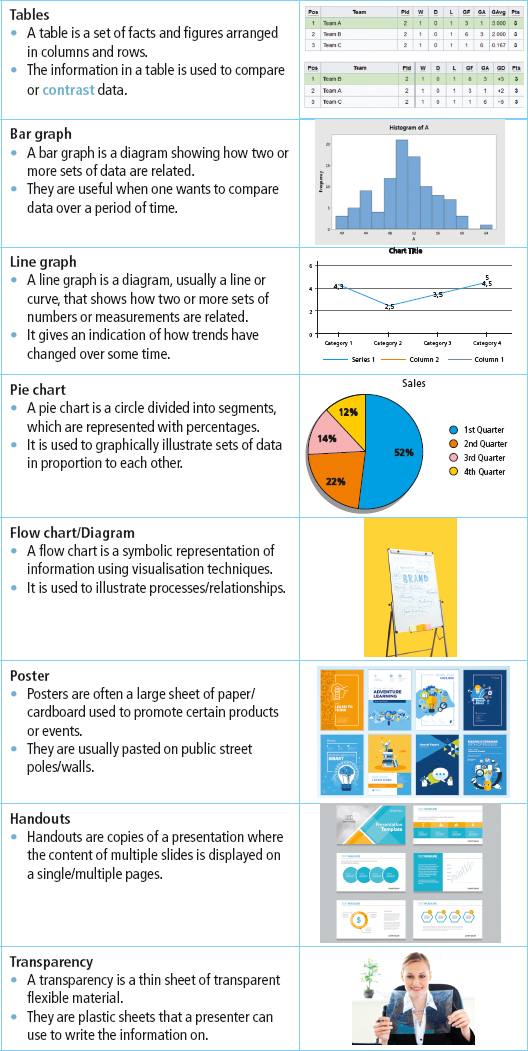
Visual aids: are charts/pictures/images that help to clarify a point/enhance a presentation.
Flipchart: a large pad of paper, bound so that each page can be turned over at the top to reveal the next page, used on a stand.
Graphs: diagrams that show the relationship between two or more sets of numbers.
Tables: a set of facts and figures arranged in columns and rows.
Diagrams: illustration of information using visualisation techniques.
Posters: a large sheet of paper/cardboard promoting certain products or events that can be displayed on public street poles/walls.
Handouts: printed information provided to the audience to accompany a presentation.
Transparencies/slides: a visual presentation of data/audio/video on a screen.
Business reports: formal written documents outlining factual information to stakeholders of a business.
Flyer: a thin sheet of paper on which businesses advertise their products or services.
In Grade 10, you were introduced to the topic; Presentation of Business Information which included various types of visual aids, and guidelines on how to write a business report. We will provide a detailed analysis off this topic in Grade 11 and 12.
Entrepreneurs need to present their business plans to various stakeholders and potential investors. Entrepreneurs should know how to present business information in a professional manner and protect the business image/brand.
Successful businesses always find new ways of presenting business information to avoid using the same presentation style. They continuously update their information and consider various types of audience when preparing for a presentation.

 New words
strategies plan of action to achieve goals
New words
enables makes it possible for people to do something
There are two types of presentation, namely: verbal and non-verbal presentation. Business information can be presented verbally or non-verbally depending on the type of information that must be presented and the intended audience.
Verbal presentation |
Non-verbal presentation |
|
|
|
|
Tip 
You must know the examples of each verbal and non-verbal presentation so that you are able to identify the types of presentation from given statements/scenarios/case study.
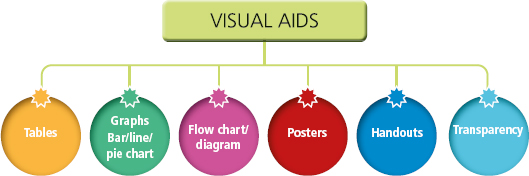
Visual aids refer to support materials such as tables, graphs, pie charts, posters used in addition to spoken information. Visual aids help presenters to provide detailed information about the topic that is presented. They make the presentation more interesting for the audience.
New words
contrast something being different from something else
Tip
You should be able to identify these visual aids from given scenarios/case studies/statements.
Using appropriate visual aids to enhance the quality of a presentation requires presenters to prepare visual aids before doing a presentation. The selection of any type of visual aids depends on the purpose of the presentation and the type of information that will be presented.

Guidelines on how to prepare transparencies, posters and handouts.

New words
refrain stop yourself from doing something

 An example of an eye catching poster

Handouts provides detailed information of the presentation
 Activity 17.1 Business information and visual aids
1.1 Identify each type of visual aid used by Lee during his business presentation to the board of directors from EACH statement below:
1.1.1 Lee used a symbolic representation of information using visualisation techniques to illustrate the processes his department followed.
1.1.2 A set of facts and figures arranged in columns and rows to compare the sales of the last three years.
1.1.3 Lee provided printed information to the boards of directors to accompany his presentation.
1.1.4 Lee used a two-dimensional drawing showing how trends have changed over a period of ten years.
(8)
The success of any presentation requires presenters to prepare for a presentation beforehand. Presenters need to consider several factors that will enable them to make a meaningful presentation. They are also able to identify and deal with challenges that may occur during the presentation.
Presenters should consider the following factors when preparing for a presentation:
Businesses need to present written reports on their financial status, sales and profitability. These reports must be presented to various stakeholders such as shareholders/customers/employees/suppliers/creditors/government/community, etc.

New words
image general impression that a person, organisation, or product presents to the public.
In this section we will learn about the different types of written business presentations. These include the following:


New words
systematic to do something in a planned manner
1.1 List any THREE types of visual aids. (3)
1.2 Read the scenario below and answer the questions that follow
GLOBAL MOBILE SPECIALIST (GMS)
Global Mobile Specialist experienced a sharp decline in sales due to the negative impact of the Covid-19 pandemic. The directors of GMS included a report with recommendations on how to improve the business sales.
1.2.1 Identify the type of written information used by the directors of GMS. Motivate your answer by quoting from the scenario above. (3)
1.2.2 Explain TWO other types of written information. (6)
1.3 Advise businesses on the reasons why business presentations must be in a written format. (6)
New words
cohesive working together in a unified manner
Stakeholders rely on business reports to keep them updated regarding the risks associated with their investments, and the expected return on their investments. The reports must be cohesive documents based on reliable data and information. Creating a report that meets the requirements of the stakeholders is a skill that can be acquired through practice.
Guidelines on the steps in report writing:
Step 1 |
Decide on terms of reference |
|
Step 2 |
Conduct research |
|
Step 3 |
Write an outline |
|
Step 4 |
Write the first draft |
|
Analyse data and record findings |
|
|
Step 6 |
Recommend a course of action |
|
Step 7 |
Edit and distribute |
|
[Source: Adapted from https://www.indeed.com/career-advice/career-development/how-to-write-a-report, Date accessed: 25 April 2021, Publisher: Indeed Editorial Team]
After the distribution of any business report, the author will need to reflect on its effectiveness. He/she needs to determine if the report achieved its desired objectives. An honest/truthful reflection will provide the author with the necessary information to improve his/her next business report.
Consider the following areas for improvement of a business report:
Tip
Do not confuse responding to feedback after a presentation with the factors the presenter must consider before the presentation.
After a presentation, a presenter should be prepared to answer questions from their audience/the stakeholders. The audience/stakeholders must be allowed to ask clarity questions from the presenter. The presenter must be prepared to answer such questions, cordially. The answers provided must fill the gaps left out during the presentation.
New words
cordial in a friendly way
Consider the following factors when responding to questions after a presentation:
A flyer is a thin sheet of paper on which businesses advertise their products or services. The main purpose of developing flyers is to promote the business’ products or services. These flyers are usually distributed in large quantities in public places. The cost of creating and distributing the flyers is relatively low when compared to other forms of advertising.
The following factors must be considered when composing flyers:

Flyers promote products/services
Activity 17.3 Essay question on presentation of information
Businesses are expected to present their financial statements to various stakeholders. Business information could be presented verbally or non-verbally. Presenters can use visual aids to enhance the quality of their presentations. They should also consider various factors when preparing a presentation before presenting.
Write an essay on the presentation of information in which you include the following:
[40]
Use the mind map as a guide to consolidate the content covered in this topic. Be sure to study the content relevant to each heading.

QUESTION 1
1.1 Various options are provided as possible answers to the following questions. Choose the answer and write only the letter (A – D) next to the question number (1.1 – 1.5).
1.1.1 A … presentation refers to the use of speech by the presenter to convey a message to stakeholders.

1.1.2 Thandi used a … graph to show how fashion trends have changed over the past five years.
1.1.3 Donovan used … to complement his presentation with summarised notes.
1.1.4 Presentation of business information allows management to know more about competitive … strategies.
1.1.5 Gail forwarded the flyer she created to her colleague to … before printing it.
(5 × 2) (10)
QUESTION 2
2.1 State FOUR types of written information. (4)
2.2 Read the scenario below and answer the questions that follow.
CALEB SOFTWARE SOLUTIONS (CSS)
Caleb Software Solutions developed a new app to update the processing of data. The software developer used a symbolic representation of processes involved in the app to present to the management of CSS.
2.2.1 Identify the type of visual aid used by CSS. Motivate your answer by quoting from the scenario above. (3)
2.2.2 Explain any TWO other types of visual aids. (6)
2.3 Discuss how the presenter must prepare the following visual aids:
2.4 Advise businesses on the reasons why business presentations must be in a written format. (6)
Many factors must be considered when preparing for a business presentation. Sometimes business information is presented in a written report to stakeholders. An important part of a presentation is the feedback session after the presentation to ensure presenters can improve on their next presentation.
Write an essay on the presentation of information in which you include the following:
 QR CODE
Scan this code for a summary overview of the content covered in this topic relating to the specific Key Learning Points

https://www.youtube.com/playlist?list=PLY8n0zQCEkpoSJuohXHcDHDsxpXbniaM6
BUSINESS STUDIES
GRADE 11
TERM 3
SBA TASK
PROJECT
BUSINESS STUDIES
Grade 11 |
Term 3 |
School: _____________________________________ |
Task: 04 |
PROJECT
Marks: 50
Issue Date: __________________ Submission Date: _________________
Surname of Learner: __________________________________________
Name of Learner: ____________________________________________
BUSINESS VENTURES:
FINAL MARK: 50
1. This project will assess the following topics:
2. This project should be done by learners as individuals.
3. Read the instructions of each question and respond appropriately.
4. You are required to submit your completed project to your teacher for assessment.
5. You will lose marks for plagarism.
6. You must adhere to the submission date to avoid unnecessary penalties.
QUESTION 1
1.1 Visit the local entrepreneur and request him/her to respond to the following questions on entrepreneurial qualities and success factors.
1.1.1 Outline your entrepreneurial qualities and explain how these qualities have contributed towards the success of your business. (5)
1.1.2 State any THREE areas of weaknesses and explain how you will improve them. (5)
1.2 Analyse his/her action plan and explain the steps that he/she must follow when drawing an action plan. (5)
1.3 Advise him/her on steps that must be considered when planning a project. (5)
1.4 Explain aspects that he/she must consider when initiating or setting up a business venture. (5)
1.5 Name the sources of capital used by the entrepreneur when setting up his/her business. Suggest other sources. (5)
1.6 Describe factors that influence the choice of funding. (5)
1.7 Discuss reasons why he/she needs funding. (5)
1.8 The presentation of business- related information must be accurate and concise.it also important for to presenter to respond professionally to questions and feedback after the presentation.
1.8.1 Explain factors that the presenter must consider when preparing a presentation. (5)
1.8.2 Discuss any FIVE types of visual aid that the presenter must consider for the presentation. (5)
[50]
Rubric to assess the grade 11 project


MARKS: 100 TIME: 1,5 HOURS |
Instructions and information
This paper consists of 5 pages
Read the following instructions carefully before answering the questions.
1. This question paper consists of THREE sections and covers TWO main topics.
SECTION A: COMPULSORY
SECTION B: Consists of THREE questions.
Answer any TWO of the three questions in this section.
SECTION C: Consists of TWO questions.
Answer any ONE of the two questions in this section.
2. Read the instructions for each question carefully and take note of what is required.
3. Number the answers according to the numbering system used in this question paper. No marks will be awarded for answers that are numbered incorrectly.
4. Except where other instructions are given, answers must be written in full sentences.
5. Use the mark allocation and nature of each question to determine the length and depth of an answer.
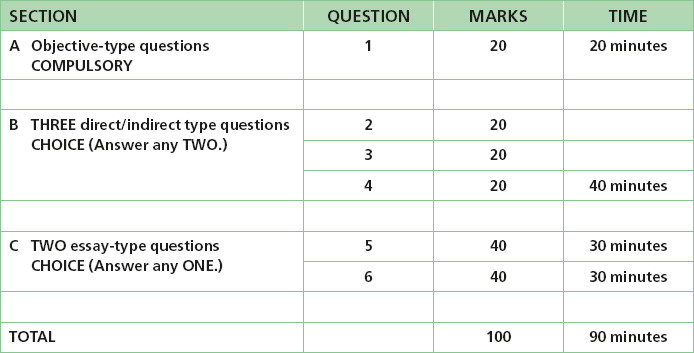
6. Use the table below as a guide for mark and time allocation when answering each question.
7. Begin the answer to EACH question on a NEW page, for example QUESTION 1 – new page, QUESTION 2 – new page, and so on.
8. You may use a non-programmable calculator.
9. Write neatly and legibly.
QUESTION 1
1.1 Various options are provided as possible answers to the following questions. Choose the answer and write only the letter (A – D) next to the question number (1.1.1 – 1.1.5).
1.1.1 An/A...is a person who starts and manages his/her own business.
1.1.2 The main aim of a Non-governmental organisation is to address…
1.1.3 A … is a set of facts and figures arranged in columns and rows.
1.1.4 Presenters use a big and bold font when preparing…
1.1.5 Plastic sheet that the presenter can use to write information on is called ...
(5 × 2) (10)
1.2 Choose a description from COLUMN B that matches a term in COLUMN A. Write only the letter (A – J) next to the question number (1.3.1 – 1.3.5) in the ANSWER BOOK, for example, 1.3.6 I.

1.2.1 The ... serves as a roadmap that provides direction to business.
1.2.2 Sanele must consider … when initiating the business, he would like to establish.
1.2.3 Gail used a … presentation when she used speech to report on the financial results of the business.
1.2.4 Businesses can ensure that they remain profitable and sustainable through proper …
1.2.5 Institutions like … can play an important role in the social and economic development of communities:
(5 × 2) (10)
TOTAL SECTION A [20]
QUESTION 2 BUSINESS VENTURES
2.1 Name FIVE key success factors related to entrepreneurship. (5)
2.2 Read the scenario below and answer the questions that follow:
JONAS SOLAR SPECIALIST (JSS)
Jonas Solar Specialist is a business that installs solar panels. JSS has suffered a financial loss during the stage five hard lockdown period in 2020 but he did not give up on his business.
2.2.1 Identify the quality of an entrepreneur applicable to the scenario above. Motivate your answer by quoting from the scenario. (3)
2.2.2 Explain TWO other qualities of an entrepreneur. (6)
2.3 Describe THREE strategies that businesses can use to ensure that they remain profitable and sustainable. (6)
[20]
QUESTION 3 BUSINESS VENTURES
3.1 List TWO sources of funding. (2)
3.2 Identify the factors that Geely considered before starting her business in the statements below:
3.2.1 She developed a long term vision for her business. (2)
3.2.2 Did a joint advertising campaign with another business. (2)
3.2.3 Established good relationship with clients.
(2) (3 × 2) (6)
3.3 Discuss the importance of an action plan. (6)
3.4 Advise businesses on the reasons why business presentations must be in a written format. (6)
[20]
QUESTION 4 BUSINESS VENTURES
4.1 Name THREE factors that influence the choice of funding. (3)
4.2 Elaborate on the meaning of an action plan. (4)
4.3 Read the scenario below and answer the questions below:
WAVECREST CONSTRUCTION ENGINEERS (WCE)
Wavecrest Construction Engineers was awarded a tender to build 1 000 houses. The management team met with the employees and provided them with a tool that listed all the activities that needed to be done and the date order on which they should be completed.
4.3.1 Identify the planning tool applicable in the scenario above. Motivate your answer by quoting from the scenario. (3)
4.3.2 Discuss TWO other planning tools that businesses could use. (6)
4.4 Advise businesses on the factors that must be considered when composing a flyer. (4)
[20]
TOTAL SECTION B [20]
QUESTION 5 BUSINESS VENTURES (PRESENTATION OF INFORMATION )
Businesses are required to write reports on their performance. Some businesses follow the correct steps report writing to ensure that accurate information is presented to stakeholders. Managers must also know all the factors they must consider when preparing a presentation. Many businesses advise their presenter to handle feedback from the audience in a non-aggressive and professional manner.
Write an essay on the presentation of information in which you include the following aspects:
[40]
QUESTION 6 BUSINESS ROLES (CITIZENSHIP ROLES AND RESPONSIBILITIES)
Every citizen in a country has certain rights and responsibilities. Circumstances in communities require businesses to be involved in social programmes. Businesses contribute to the social and economic development of communities in a variety of ways. Institutions also contribute towards social and economic development of communities.
Write an essay on citizenship roles and responsibilities in which you include the following aspects:
[40]
TOTAL SECTION C [40]
GRAND TOTAL [100]
 Key concepts

